Catalogue
Nutrient deficiencies in plants
Choose your crop and find the picture that looks most like your leaf. Each card explains how to recognise it, why it happens and what to do. Common diseases that are confused with deficiencies are on the same page.
If it starts on the lower (old) leaves
The plant moves these nutrients from old to young leaves: most likely nitrogen, phosphorus, potassium or magnesium.
If it starts on the upper (young) leaves
These nutrients are not moved: iron, zinc, manganese, sulphur, boron or calcium. In calcareous soils, iron and zinc are the most common.
Choose the crop
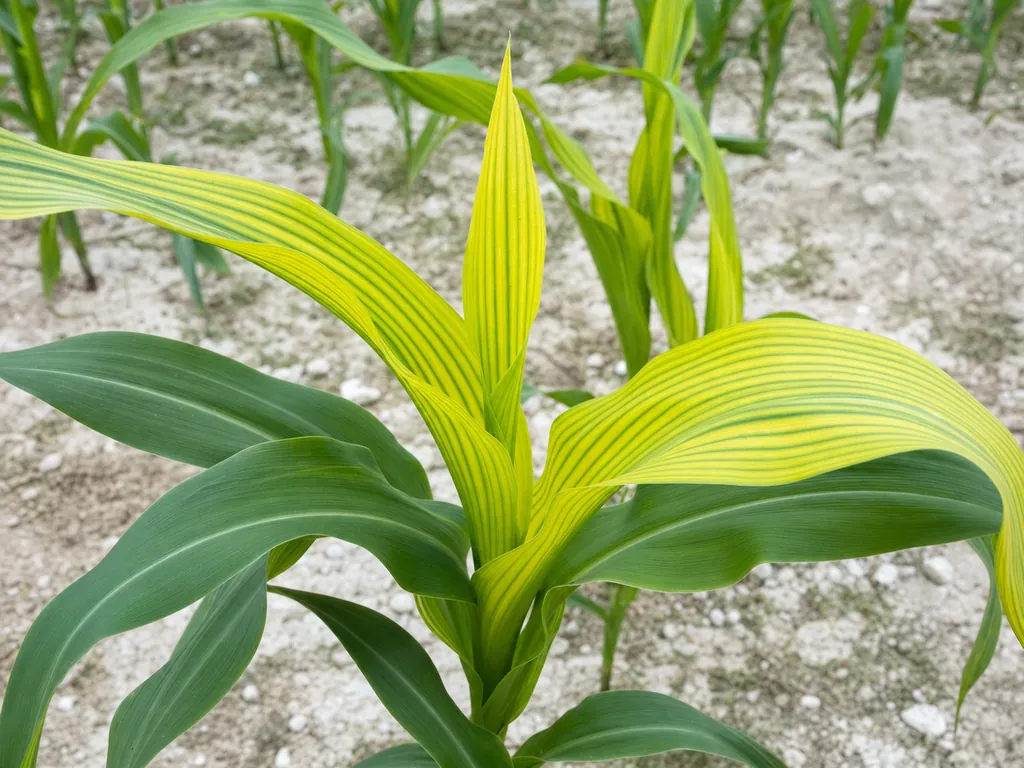
Maize · 6 deficiency
Diseases confused with deficiencies
Maize · 3 disease
Yellowing and spots that do not improve with fertiliser may be a disease. Each card explains how to recognise the disease and tell it apart from the similar deficiency.
- 1Is there powder, mould or pustules?A powder that wipes off with a finger, mould on the underside or pustules point to disease. In a deficiency the leaf surface is clean.
- 2How is it spread in the field?A deficiency is usually spread evenly over part of the field. A disease starts in patches or on single plants and spreads fast.
- 3Is the pattern of the spots regular?A deficiency follows a regular pattern on the leaf: from the edge, between the veins or from the tip. Disease spots are scattered and have rings or a coloured border.
This information helps you recognise the problem; it is not a plant protection recommendation. To decide on treatment and choose a product, consult your local agricultural advisory office or your agronomist.
The pictures are examples to help recognise the symptoms. The same deficiency or disease can look different depending on variety, soil and weather, and several deficiencies can occur at once. Your soil analysis is the simplest way to confirm this estimate.